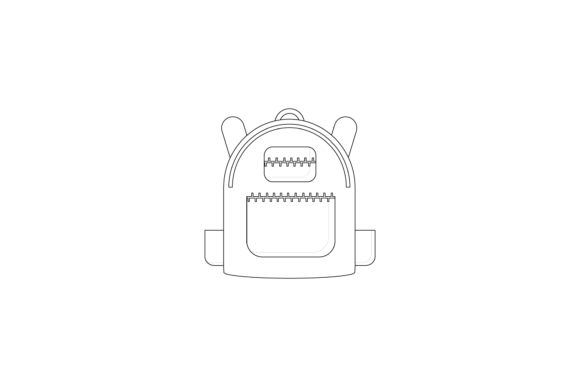
Back to School Backpack Outline
The start of a new school year carries a particular energy—a blend of anticipation, preparation, and the promise of fresh beginnings. For creators, educators, small business owners, and anyone involved in producing content or products tied to this seasonal rhythm, having the right design assets can make all the difference. That is exactly where the Back to School Backpack Outline enters the picture. This digital product, delivered as a set of six versatile files, offers a clean, adaptable starting point for a wide range of projects. Whether you are designing a classroom handout, creating a custom sticker for a local PTA fundraiser, or building a marketing campaign for a tutoring service, this outline gives you a professional foundation without requiring you to start from scratch.
At first glance, it may seem like a simple vector graphic of a backpack. But in practice, it represents something larger: the intersection of convenience, creativity, and the modern shift toward digital-first workflows. The Back to School Backpack Outline is not just a drawing; it is a tool that saves time, ensures consistency, and opens up possibilities for customization. Let us explore why this type of resource has become relevant, how it fits into current creative and professional trends, and what practical value it offers to people who work with visual content every day.
What the Back to School Backpack Outline Offers
The product itself is straightforward but thoughtfully assembled. You receive six digital files in total, each formatted for a specific use case. The canvas size is set at 1920 pixels by 1280 pixels, a dimension that works well for web graphics, social media posts, print materials, and even some signage. The formats include an AI file (Adobe Illustrator), an EPS file (Encapsulated PostScript), an SVG file (Scalable Vector Graphics), a DXF file (Drawing Exchange Format), a JPG file, and a PNG file. This range means that whether you are a graphic designer working in professional software, a hobbyist using a home cutting machine, or a teacher who simply needs a crisp image for a worksheet, there is a version ready for you.
Each format serves a distinct purpose. The AI and EPS files are editable vector formats that allow you to tweak every anchor point, change colors, resize without losing quality, and integrate the outline into larger compositions. The SVG file is ideal for web use, responsive design, and many modern crafting tools. The DXF file is commonly used with laser cutters, vinyl plotters, and CNC machines, making it a practical choice for physical production. Meanwhile, the JPG and PNG files provide ready-to-use raster versions for quick insertion into documents, presentations, or social media posts. This breadth of compatibility reflects a deep understanding of how diverse the audience for such a product really is.
Why This Type of Resource Matters Now
The relevance of the Back to School Backpack Outline goes beyond the simple utility of having a graphic on hand. It speaks to several broader shifts in how people work, create, and consume content. One of the most significant trends is the continued growth of the creator economy and the rise of small-scale entrepreneurship. Platforms like Etsy, Creative Market, and even local craft fairs have enabled thousands of individuals to turn design skills into income. For these creators, time is a precious commodity. A ready-made outline that can be customized, recolored, and adapted for multiple products—stickers, tote bags, bookmarks, digital planners, and more—cuts down on the repetitive work of drawing basic shapes. Instead, the creator can focus on the unique value they add: the color scheme, the typography, the additional elements that make a product their own.
Similarly, the education sector has undergone a lasting transformation in how materials are produced. Teachers and homeschooling parents are increasingly designing their own worksheets, bulletin board decorations, and classroom resources. A clean, scalable outline of a backpack can be used in countless ways: as a template for a coloring activity, as a visual cue on a daily schedule, or as a cut-out for a hands-on project. The fact that the design comes in a DXF format also means that educators with access to a cutting machine can produce durable felt or vinyl versions for classroom displays. This is not just about having a pretty picture—it is about having a reliable building block that supports learning and organization.
Marketing professionals and small business owners also benefit from the seasonal nature of back-to-school content. Whether it is a social media campaign for a local bookstore, a flyer for a back-to-school event, or an email header for a tutoring service, the backpack outline provides immediate visual recognition. It signals the theme clearly without requiring a full illustration. In an era where visual communication is often the first point of contact with an audience, having a clean, versatile asset like this can streamline production and ensure brand consistency across different channels.
How the Product Fits into Modern Workflows
The evolution of design tools and digital workflows has made vector outlines more accessible than ever. Even a few years ago, working with an AI or EPS file typically required expensive software like Adobe Illustrator. Today, free and low-cost alternatives such as Inkscape, GIMP, Canva Pro, and even some online SVG editors allow users to open, edit, and export vector files without a major investment. This democratization of design means that the Back to School Backpack Outline is usable by a much broader audience. A freelance blogger who wants to create a custom image for a post about school supplies can open the SVG file in a free editor, change the stroke color to match their brand palette, and publish it within minutes. A small business owner who runs a print-on-demand shop can import the DXF file into their cutting software and produce a batch of iron-on transfers for tote bags in an afternoon.
This ease of integration is a key reason why pre-made outlines have become a staple in the digital asset landscape. They are not replacements for original art, but rather starting points that respect the creator’s time and skill. The fact that the product includes both vector and raster formats also acknowledges the reality that no single file type works for every situation. A PNG with a transparent background is perfect for layering onto a social media post; an AI file is better suited for a multi-page brochure. By providing all six, the product removes friction from the workflow. You do not have to convert formats, worry about losing quality, or search for a separate tool to get the job done.
Practical Implications for Different Audiences
For the independent creator, the practical value is clear. One purchase can lead to multiple end products. A sticker sheet for a back-to-school collection might feature the backpack outline alongside other school-themed icons. A digital planner for parents could use the outline as a recurring decorative element. A printable gift tag or card could incorporate the design as a central motif. The outline’s simplicity is actually an advantage—it can be filled with patterns, used as a stencil, or combined with text and other graphics without clashing. Because the file is fully editable, the creator can also adjust the thickness of the lines, round corners, or break the outline into separate pieces if the project requires it.
For educators, the outline serves a slightly different purpose. It becomes a resource for non-commercial classroom use, saving time during lesson preparation. A teacher might use the PNG version to create a name tag template for lockers or cubbies. The SVG version could be used to design a classroom jobs chart where each student’s name appears on a backpack icon. The DXF version could produce a set of laminated cutouts for a sorting activity. In this context, the outline is not just a design element—it is a functional part of the learning environment. The fact that it comes from a digital product means it can be used year after year, resized, recolored, and adapted as needed.
Marketers and business owners, meanwhile, can leverage the asset to maintain a consistent visual theme across seasonal campaigns. A real estate agent hosting a back-to-school supply drive might use the backpack outline on social media posts, flyers, and website banners. A children’s clothing boutique could incorporate it into an email newsletter promoting school outfits. The outline acts as a unifying symbol that viewers instantly associate with the back-to-school period. Because the file is high-resolution and scalable, it works equally well on a phone screen and a printed poster.
Recommendations for Getting the Most Out of This Asset
To truly maximize the value of the Back to School Backpack Outline, consider a few practical approaches. First, take advantage of the editable vector formats (AI, EPS, SVG) to build a small library of variations. Create a version with a solid fill, a version with a dashed stroke, a version with rounded corners, and a version that is flipped or rotated. This way, you have multiple options ready for future projects without having to edit from scratch each time. Second, combine the outline with other simple shapes or icons—such as a book, apple, or pencil—to create a cohesive set of back-to-school graphics. The uniformity of line style across the collection will make your projects look polished and professional.
Third, experiment with color. The outline is intentionally minimal, which makes it a perfect candidate for bold, seasonal color schemes. Try a bright yellow and orange combination for a cheerful feel, or a navy and gold palette for a more traditional look. If you are using the outline for a client project, match it to their brand colors for a seamless integration. Fourth, consider the DXF file if you have access to a laser cutter, vinyl cutter, or CNC router. Physical products made from this outline—such as wooden keychains, acrylic signs, or fabric patches—can be sold at craft fairs or used as giveaways. The transition from digital to physical is smoother than ever, and a clean outline is the ideal starting point for that process.
Finally, store the files thoughtfully. Because you receive six formats, you may not need all of them for every project. Keep the AI or EPS file as your master editable version, use the SVG for web and lightweight editing, and save the JPG and PNG for quick inserts. The DXF can live in a separate folder for fabrication projects. Good file management ensures that months later, when the next back-to-school season rolls around, you can find exactly what you need without searching through cluttered downloads.
A Thought on Why Digital Outlines Are Here to Stay
The growing popularity of digital assets like the Back to School Backpack Outline is not a passing trend. It reflects a deeper change in how we think about design and production. Instead of every project requiring a fully custom illustration, many creators and professionals now build their work around modular, reusable components. This approach is faster, more cost-effective, and often leads to more consistent output. The backpack outline is a small but meaningful example of that shift. It acknowledges that not every design needs to be a masterpiece—sometimes, what you need is a reliable, well-made tool that lets you focus on the parts of the project that require your unique expertise.
Whether you are a teacher preparing materials for a new class, a small business owner building a seasonal product line, or a freelance designer juggling multiple clients, having access to a thoughtfully prepared outline can simplify your process. It reduces friction, supports creativity, and gives you a professional starting point. The Back to School Backpack Outline, with its six-file set and careful attention to format variety, is designed precisely with that kind of practical, everyday use in mind. And as the boundaries between digital and physical creation continue to blur, tools like this will only become more valuable. They are not shortcuts; they are enablers. They let you spend less time on the basics and more time on what actually matters—bringing your ideas to life.